OFFICE AUTOMATION SYSTEM
The versatility of  components allows for flexible control of service sector applications, especially in the context of office buildings; similar to hotel installations, the requirements
of office building applications are perfectly covered by Vimar EIB
components.
components allows for flexible control of service sector applications, especially in the context of office buildings; similar to hotel installations, the requirements
of office building applications are perfectly covered by Vimar EIB
components.
Access control is a central function in modern buildings; Vimar
offers a wide range of products and stand-alone systems with
card chips and transponders for professional applications in
which there are no special specifications for continuous monitoring
of transits.
For higher level requirements and interoperability with other
intelligent control devices, the Well-contact Plus system devices,
developed on the KNX/EIB standard platform, can satisfy all
needs; from door opening control to complete management
of lights and temperature, with total programmability per floor,
per side of the building or even per office, while providing full
expandability with commercially available components thanks
to the implementation of the KNX standard, thus satisfying even
the most sophisticated and specific requirements.
The following example illustrates the devices of Well-contact Plus in a typical office where separated access to several local offices is required to manage and also supervise from the reception PC.


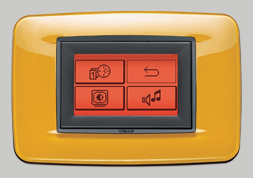

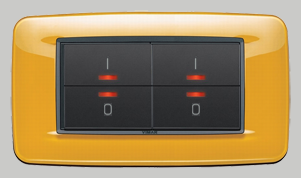


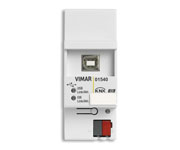
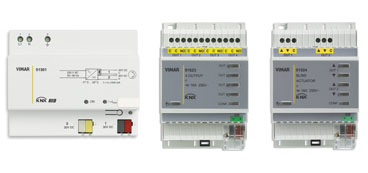

The system can thus implement the widest range of applications:
from access diversification, to customization of each
office including card generation for access to common areas
such as, for instance, main entrances, canteens/restaurants,
reserved sitting rooms, conference rooms, etc., all with the use
of transponder readers.
The pocket reader allows full control of lighting and temperature
in all areas not generally controlled by timers. (Optimised energy
consumption).
Office lighting is by now the subject of specific design studies;
controlling lights not only manually but with timers and programs
which also consider exposure to sunlight, makes for significant
energy savings. Door panels, for instance, can be connected to
light sensors which detect the lighting level at which to turn on
the lights, depending on the set threshold.
The same devices can also be used for signaling status and
alarms directly from auxiliary contacts or remote sensors, which
can then be displayed on both the readers themselves and on
the supervisor PC (if present).
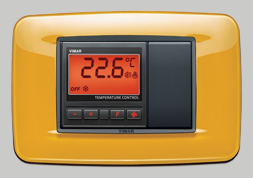
As for temperature control, the potential in modern office buildings
to turn on the heating or A/C in a differentiated manner is
increasingly a requirement for both comfort and energy savings;
all of this can be done with fully programmable Well-contact Plus
system thermostats.